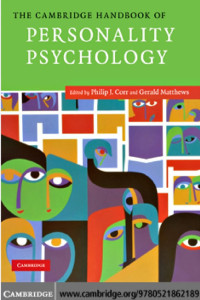
Text
The Cambridge Handbook of Personality Psychology
The Cambridge Handbook of Personality Psychology provides a comprehensive overview of contemporary personality psychology. It brings together contributions from leading international researchers to examine personality from a wide range of theoretical, methodological, biological, cognitive, social, cultural, clinical, and applied perspectives. The book covers the foundations of personality theory, personality description and measurement, development and health, biological and cognitive processes, social and cultural influences, psychopathology, and applications of personality psychology. It is intended as a major reference work for students, researchers, and practitioners in psychology and related social and behavioral sciences.\\r\\n\\r\\nList of Figures\\r\\nList of Tables\\r\\nList of Contributors\\r\\nList of Abbreviations\\r\\nPreface\\r\\nEditors’ General Introduction\\r\\nEditors’ Introduction to Parts I to VIII\\r\\nPart I — Foundation Issues\\r\\nConceptual Issues in Personality Theory\\r\\nPersonality Psychology of Situations\\r\\nPersonality: Traits and Situations\\r\\nPersonality and Emotion\\r\\nThe Characterization of Persons: Some Fundamental Conceptual Issues\\r\\nPart II — Personality Description and Measurement\\r\\nThe Trait Approach to Personality\\r\\nMethods of Personality Assessment\\r\\nStructural Models of Personality\\r\\nThe Five-Factor Model of Personality Traits: Consensus and Controversy\\r\\nPersonality and Intelligence\\r\\nPart III — Development, Health and Personality Change\\r\\nChildhood Temperament\\r\\nThe Development of Personality Across the Lifespan\\r\\nModels of Personality and Health\\r\\nAttachment Theory: I. Motivational, Individual-Differences and Structural Aspects\\r\\nAttachment Theory: II. Developmental, Psychodynamic and Optimal-Functioning Aspects\\r\\nPart IV — Biological Perspectives\\r\\nEvolutionary Theories of Personality\\r\\nAnimal Models of Personality and Cross-Species Comparisons\\r\\nBehavioural Genetics: From Variance to DNA\\r\\nNeuroimaging of Personality\\r\\nPersonality Neuroscience: Explaining Individual Differences in Affect, Behaviour and Cognition\\r\\nThe Reinforcement Sensitivity Theory of Personality\\r\\nPart V — Cognitive Perspectives\\r\\nSemantic and Linguistic Aspects of Personality\\r\\nPersonality and Performance: Cognitive Processes and Models\\r\\nSelf-Regulation and Control in Personality Functioning\\r\\nSelf-Determination Theory: A Consideration of Human Motivational Universals\\r\\nTraits and the Self: Toward an Integration\\r\\nPersonality as a Cognitive-Affective Processing System\\r\\nPart VI — Social and Cultural Processes\\r\\nThe Storied Construction of Personality\\r\\nPersonality and Social Relations\\r\\nPersonality and Social Support Processes\\r\\nSocial Pain and Hurt Feelings\\r\\nPersonality in Cross-Cultural Perspective\\r\\nCulture and Personality\\r\\nPersonality and Politics\\r\\nPart VII — Psychopathology\\r\\nMood and Anxiety Disorders: The Hierarchical Structure of Personality and Psychopathology\\r\\nPersonality and Psychosis\\r\\nDiagnosis and Assessment of Disorders of Personality\\r\\nPsychopathy and Its Measurement\\r\\nPersonality and Eating Disorders\\r\\nPersonality and Attention Deficit Hyperactivity Disorder\\r\\nPart VIII — Applied Personality Psychology\\r\\nPersonality in School Psychology\\r\\nPersonality in Educational Psychology\\r\\nPersonality at Work\\r\\nWorkplace Safety and Personality\\r\\nPersonality and Crime\\r\\nTreatment of Personality Disorders\\r\\nIndex
Ketersediaan
Informasi Detail
- Judul Seri
-
-
- No. Panggil
-
155.2 GER t
- Penerbit
- Cambridge, New York : Cambridge University Press., 2009
- Deskripsi Fisik
-
liv, 850 pages ; 26 cm
- Bahasa
-
English
- ISBN/ISSN
-
9780521862189
- Klasifikasi
-
155.2
- Tipe Isi
-
-
- Tipe Media
-
-
- Tipe Pembawa
-
-
- Edisi
-
1
- Subjek
- Info Detail Spesifik
-
-
- Pernyataan Tanggungjawab
-
Philip J. Corr, Gerald Matthews
Versi lain/terkait
Tidak tersedia versi lain
Lampiran Berkas
Komentar
Anda harus masuk sebelum memberikan komentar
 Karya Umum
 Filsafat
 Agama
 Ilmu-ilmu Sosial
 Bahasa
 Ilmu-ilmu Murni
 Ilmu-ilmu Terapan
 Kesenian, Hiburan, dan Olahraga
 Kesusastraan
 Geografi dan Sejarah