Text
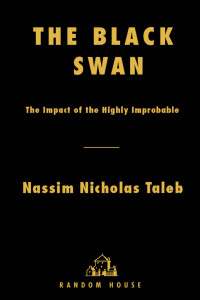
The Black Swan : The Impact of the Highly Improbable
The Black Swan: The Impact of the Highly Improbable examines the profound role of highly improbable events in human life, history, science, economics, and decision-making. Nassim Nicholas Taleb introduces the concept of the “Black Swan,” an event that is difficult to predict, has an extreme impact, and is often explained retrospectively as though it had been predictable. Through discussions of randomness, probability, uncertainty, forecasting, knowledge, and human cognitive biases, Taleb challenges the tendency to rely on past experience and conventional statistical models when confronting an uncertain future. He explores why people are prone to narrative fallacies, confirmation bias, and excessive confidence in experts and predictions, and distinguishes between “Mediocristan,” where extreme events are relatively limited, and “Extremistan,” where rare events can have disproportionate consequences. The book ultimately encourages readers to recognize uncertainty, question conventional assumptions, and become more resilient to unexpected events. Contents: Prologue: On the Plumage of Birds; Part One: Umberto Eco\\\'s Antilibrary, or How We Seek Validation; Chapter 1: The Apprenticeship of an Empirical Skeptic; Chapter 2: Yevgenia\\\'s Black Swan; Chapter 3: The Speculator and the Prostitute; Chapter 4: One Thousand and One Days, or How Not to Be a Sucker; Chapter 5: Confirmation Shmonfirmation!; Chapter 6: The Narrative Fallacy; Chapter 7: Living in the Antechamber of Hope; Chapter 8: Giacomo Casanova\\\'s Unfailing Luck: The Problem of Silent Evidence; Chapter 9: The Ludic Fallacy, or The Uncertainty of the Nerd; Part Two: We Just Can\\\'t Predict; Chapter 10: The Scandal of Prediction; Chapter 11: How to Look for Bird Poop; Chapter 12: Epistemocracy, a Dream; Chapter 13: Appelles the Painter, or What Do You Do If You Cannot Predict?; Part Three: Those Gray Swans of Extremistan; Chapter 14: From Mediocristan to Extremistan, and Back; Chapter 15: The Bell Curve, That Great Intellectual Fraud; Chapter 16: The Aesthetics of Randomness; Chapter 17: Locke\\\'s Madmen, or Bell Curves in the Wrong Places; Chapter 18: The Uncertainty of the Phony; Part Four: The End; Chapter 19: Half and Half, or How to Get Even with the Black Swan; Epilogue: Yevgenia\\\'s White Swans; Acknowledgments; Glossary; Notes; Bibliography; Index.
Ketersediaan
Informasi Detail
- Judul Seri
-
-
- No. Panggil
-
003.54 NAS t
- Penerbit
- New York : Random House., 2007
- Deskripsi Fisik
-
xxviii, 366 halaman : ilustrasi ; 25 cm
- Bahasa
-
English
- ISBN/ISSN
-
9781400063512
- Klasifikasi
-
003.54
- Tipe Isi
-
-
- Tipe Media
-
-
- Tipe Pembawa
-
-
- Edisi
-
1
- Subjek
- Info Detail Spesifik
-
-
- Pernyataan Tanggungjawab
-
Nassim Nicholas Taleb
Versi lain/terkait
Tidak tersedia versi lain
Lampiran Berkas
Komentar
Anda harus masuk sebelum memberikan komentar
 Karya Umum
 Filsafat
 Agama
 Ilmu-ilmu Sosial
 Bahasa
 Ilmu-ilmu Murni
 Ilmu-ilmu Terapan
 Kesenian, Hiburan, dan Olahraga
 Kesusastraan
 Geografi dan Sejarah